Prisma ORM: The Most Downloaded ORM for Node.js and TypeScript
Prisma ORM is the most downloaded ORM for Node.js and TypeScript, with 55.3 million npm downloads in the 30 days ending 5 July 2026, ahead of Drizzle (48.1 million) and TypeORM (19.3 million). Prisma ORM is an open-source, schema-first ORM: you describe your data model in a typed schema, and it generates a type-safe database client. Released for production in 2021, it reached first place in npm's download charts for ORMs in 2024 and has held it since. We are grateful to share this milestone with our community and want to take the opportunity to reflect on the past and give an outlook into the future.
Prisma vs Drizzle vs TypeORM: npm downloads in 2026
This post originally celebrated the milestone in August 2024. The claim still holds, so here are the current figures. In the 30 days ending 2026-07-05, npm reports these download counts for the most popular Node.js database libraries:
| Package | Category | npm downloads (30 days) |
|---|---|---|
prisma | ORM | 55.3 million |
drizzle-orm | ORM | 48.1 million |
kysely | Query builder | 38.5 million |
typeorm | ORM | 19.3 million |
sequelize | ORM | 11.8 million |
Source: the npm downloads API, queried on 2026-07-07. Counts refer to each library's primary npm package, the name developers and agents install. The runtime package @prisma/client shows the same picture at 50.3 million downloads in the same window. Mongoose, a MongoDB object modeler rather than a relational ORM, recorded 24.8 million.
The race is much closer than it was in 2024, and that competition has been good for everyone: it pushed major performance work across the ecosystem, including the rust-free rewrite of Prisma ORM that shipped for production in 2025 and the release of Prisma ORM 7.
What agentic engineering does to download charts
A download chart in 2026 measures something different from what it did when this post was originally published. The five-year view makes the shift hard to miss:
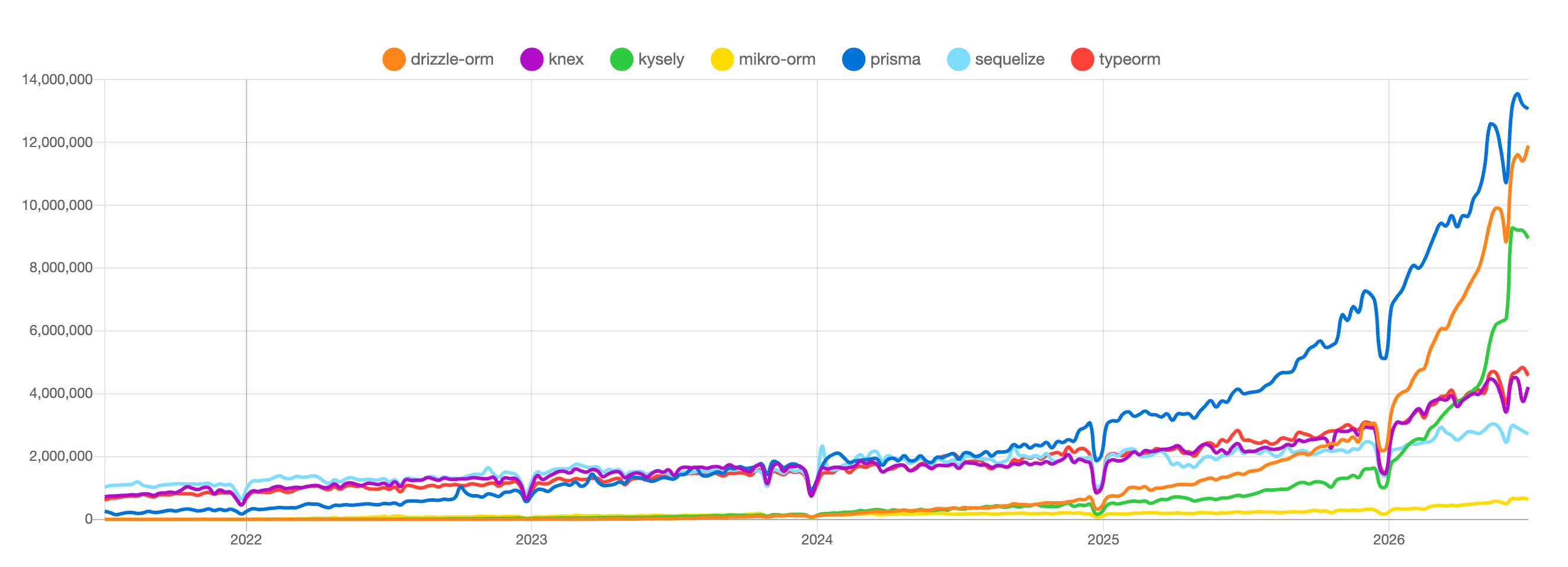
For three and a half years, every line on this chart grows roughly linearly. Starting in early 2025, the whole category bends upward. That inflection is not unique to ORMs. Between January 2025 and June 2026, monthly npm downloads of long-stable packages roughly tripled: lodash grew about 3x, express about 3.5x, and typescript about 3.6x (same npm API, same query date). The population of human developers did not triple in eighteen months. A large share of that growth comes from agentic engineering. AI coding agents install dependencies every time they scaffold, test, or deploy a project, and they typically run in a fresh container or sandbox where nothing is cached, so a single human prompt can trigger dozens of npm install runs.
The more interesting signal is how unevenly that lift is distributed. Packages that sit in the default stack of agent-built applications grew far past the baseline over those eighteen months: zod about 13x, Vercel's ai SDK about 18x, kysely about 19x, drizzle-orm about 16x, and prisma about 4.4x. The long-established ORMs moved the other way relative to baseline: sequelize grew 1.5x and typeorm and knex about 2.4x, all below the general inflation of the registry. Every multiplier here comes from the same npm downloads API, computed as each package's monthly downloads for June 2026 divided by January 2025 (queried on 2026-07-07). You can read that split directly off the chart above: the steep lines are the tools being chosen for new, largely agent-scaffolded projects, while the flat lines are existing codebases being reinstalled by CI.
Two things follow for reading the table above:
- Absolute counts are installs, and installs are increasingly machine-driven. Every package in the table is measured the same way, so the ranking is still meaningful, but a download no longer approximates a human developer the way it did in 2024. Human-anchored measures, such as monthly active developers, are the better gauge of real-world usage.
- The chart is becoming a leading indicator of agent preference. When an AI agent scaffolds an application, it also picks the database library. Download rankings for stack-choice packages now partly measure which tools coding agents reach for by default, and that choice compounds: the stacks agents scaffold today are the codebases teams maintain tomorrow.
The rest of this post covers the community that carried Prisma ORM to first place, and where the platform is going next.
Thank you to our amazing community ❤️
Becoming the most downloaded ORM in Node.js
When we launched Prisma ORM in 2021, the developer tooling and infrastructure looked very different. TypeScript was young, Serverless was still a buzzword and Edge was just about to be conceived.
Since then, Prisma ORM has gained steady popularity, reached first place in the npm download charts in 2024, and has held that spot ever since 🎉
We’re proud that Prisma ORM has pushed the TypeScript ecosystem forward and introduced the first fully type-safe layer for database interactions in Node.js and other server-side JS runtimes.
Community is the core of Prisma
Community has always been at the core of our success at Prisma! What started with developer Meetups and conferences in our early days has grown into a global community of content creators, course authors, and tool builders, with more than 500,000 developers using Prisma products every month.
We see developers create content about Prisma ORM, build tools for the Prisma ecosystem, and help each other out with questions on GitHub, Stack Overflow, and Discord. Increasingly, the community also shapes how AI coding agents work with Prisma, through shared rules files, starter templates, and tools built on the Prisma MCP server.
In short: We wouldn’t be here without the amazing support from our community — thank you!
Connect with other developers on the Prisma Discord.
A growing open-source ecosystem
A huge part of Prisma ORM’s adoption and why it makes developers so successful is thanks to the growing ecosystem around it.
Prisma ORM as the foundation of frameworks and app builders
Many web frameworks and app-building platforms have chosen Prisma ORM as their database layer, for example:
- Wasp: Full-stack web framework for React and Node.js that uses the Prisma schema as its data layer, and ships a production-ready open-source SaaS starter.
- KeystoneJS: “CMS for developers” that provides elegant APIs. Keystone lets you describe your schema in a flexible format and, from there, provides you with a database, API, and more!
- ZenStack: A full-stack toolkit built on top of Prisma that extends the schema with access control policies and auto-generated APIs.
- AI app builders: platforms like co.dev generate entire applications for non-developers, with AI agents writing the Prisma code and running on Prisma Postgres. Read the co.dev case study to see how that works in production.
Community tools for even better Prisma ORM workflows
In addition to Prisma ORM being the database foundation in these frameworks and tools, the Prisma community has built a vast amount of diverse tooling that makes development with Prisma ORM even more delightful.
From Prisma Client in other languages (like Python or Go), to generators (e.g. for visualizing DB schemas or generating Zod types), and numerous other tools like Client extensions, CLIs, and editor integrations. We feel grateful for such an active and thriving community building tools for the Prisma ecosystem.
Real-world open-source projects built on Prisma ORM
Finally, we’re excited to see the usage of Prisma ORM in real-world open-source projects. From indie hacking projects to funded startups, these example projects are a great reference if you want to see what production-grade applications look like when built on top of Prisma ORM!
If you’re interested, check out the interviews with the founders of open-source companies we’ve published on YouTube.
Where Prisma is going: one platform for agentic software development
The ORM was the first chapter of the Prisma story, and the download chart above is what that chapter looks like from the outside. The next chapter is bigger than the ORM.
Since this post was first published, the platform around the ORM has taken shape: Prisma Postgres went from early access to general availability, the ORM dropped its Rust engines for a faster TypeScript-based core, Prisma ORM 7 rebuilt the client generator around modern ESM projects, and Prisma Compute entered public beta.
The reason for that direction is the same fragmentation problem the download numbers point at. A typical backend is still stitched together from separate vendors: the database in one place, hosting in another, the ORM in the repo, and glue code plus dashboards in between. Human developers work around those seams. AI coding agents run into them constantly, because every extra dashboard, credential handoff, and vendor boundary is a step an agent cannot complete on its own.
Prisma's answer is one platform where the layers are designed to work together:
- Prisma ORM describes your data in a typed schema and generates a type-safe client. The schema is a source of truth that human developers and coding agents share.
- Prisma Postgres is managed PostgreSQL built into that workflow:
npx prisma init --dbprovisions a production database, andnpx prisma devruns a local one. - Prisma Compute, now in public beta, deploys TypeScript applications next to your database for low-latency data access.
Every layer is operable through the same programmable interfaces: the CLI, the Management API, and the MCP server. That is what a single-agent experience means in practice. An agent can define a schema, provision a database, run migrations, deploy the application, and debug it, entirely in code, with one bill and predictable spend caps at the end.
The ORM itself is being rebuilt around the same idea. Prisma Next, available in Early Access today and becoming Prisma 8 at general availability, is an agent-native TypeScript ORM. You describe your application as models and relationships in one central data contract; Prisma generates the migrations, and you or your agent write type-safe queries in terms of your models. Every query returns structured, machine-readable output, and every operation has guardrails and verifications, so an agent can parse what comes back and correct itself instead of guessing at a stack trace. The client is about 100 KB and runs at roughly 90% of raw pg throughput (benchmark). Prisma 7 remains the production version today; teams adopt Prisma Next by running it in parallel and migrating incrementally.
If download charts increasingly measure what agents choose, the way to earn that choice is to be the platform agents can operate end to end.
Frequently asked questions
To stay up-to-date about everything that’s happening in the Prismaverse, keep an eye on our changelog and follow us on X! And if you have ideas for how Prisma can be improved, always feel free to open an issue on GitHub or reach out to us on Discord.
About the author

Nikolas was employee #3 at Prisma and spent 9 years teaching developers about ORMs and databases. He left in October 2025 to focus on his own projects and work as an independent Software Engineer and Developer Educator.
Keep reading
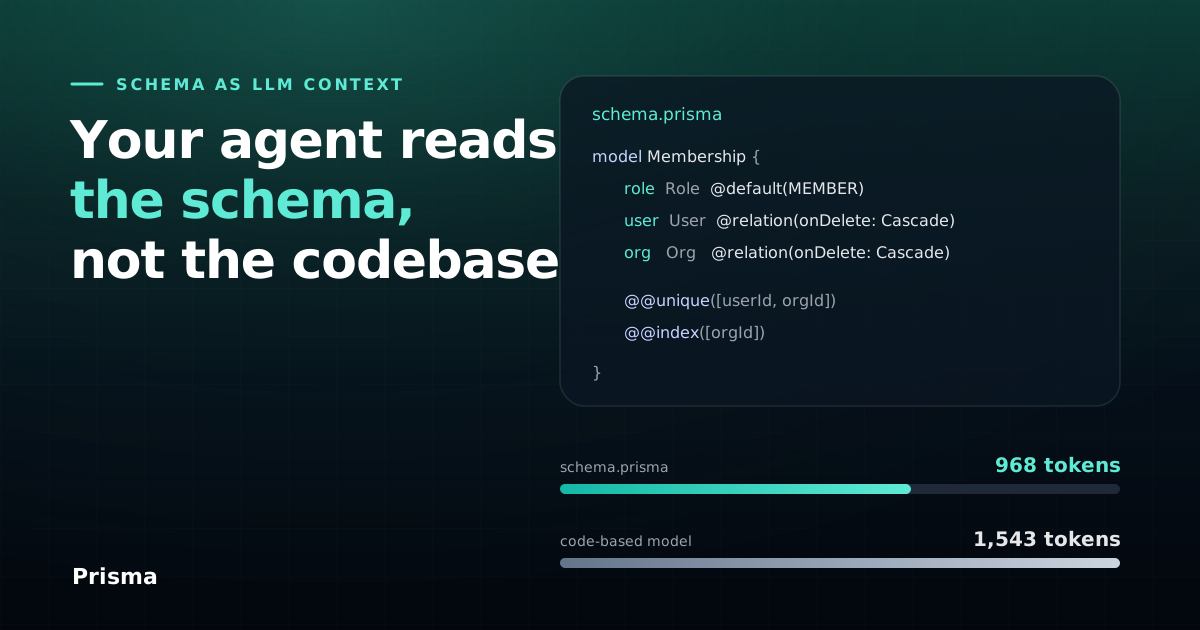
Why Your Agent Reads a Prisma Schema Better Than Your Codebase
Your data model in one declarative file. We measure what a Prisma schema costs an AI coding agent in tokens and type-check time, and what it buys.

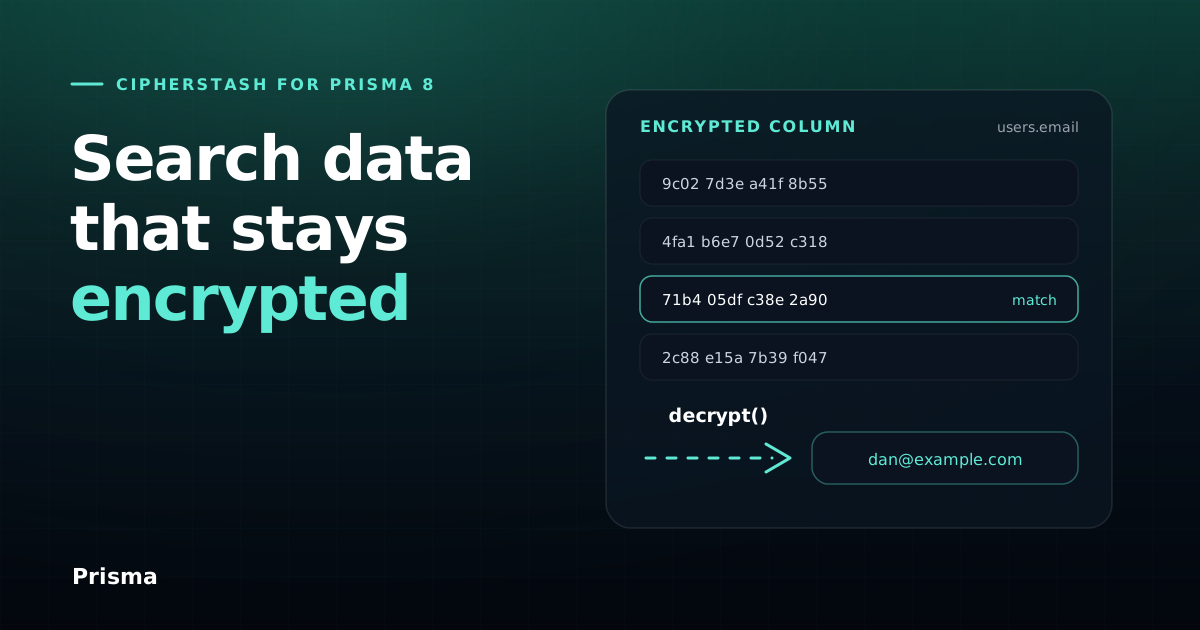
Search encrypted data with Prisma 8 and CipherStash
CipherStash brings searchable field-level encryption to Prisma 8: encrypted equality, free-text and range queries, and identity-based key management.

Build your next app with Prisma
Start free. Scale when you’re ready.